
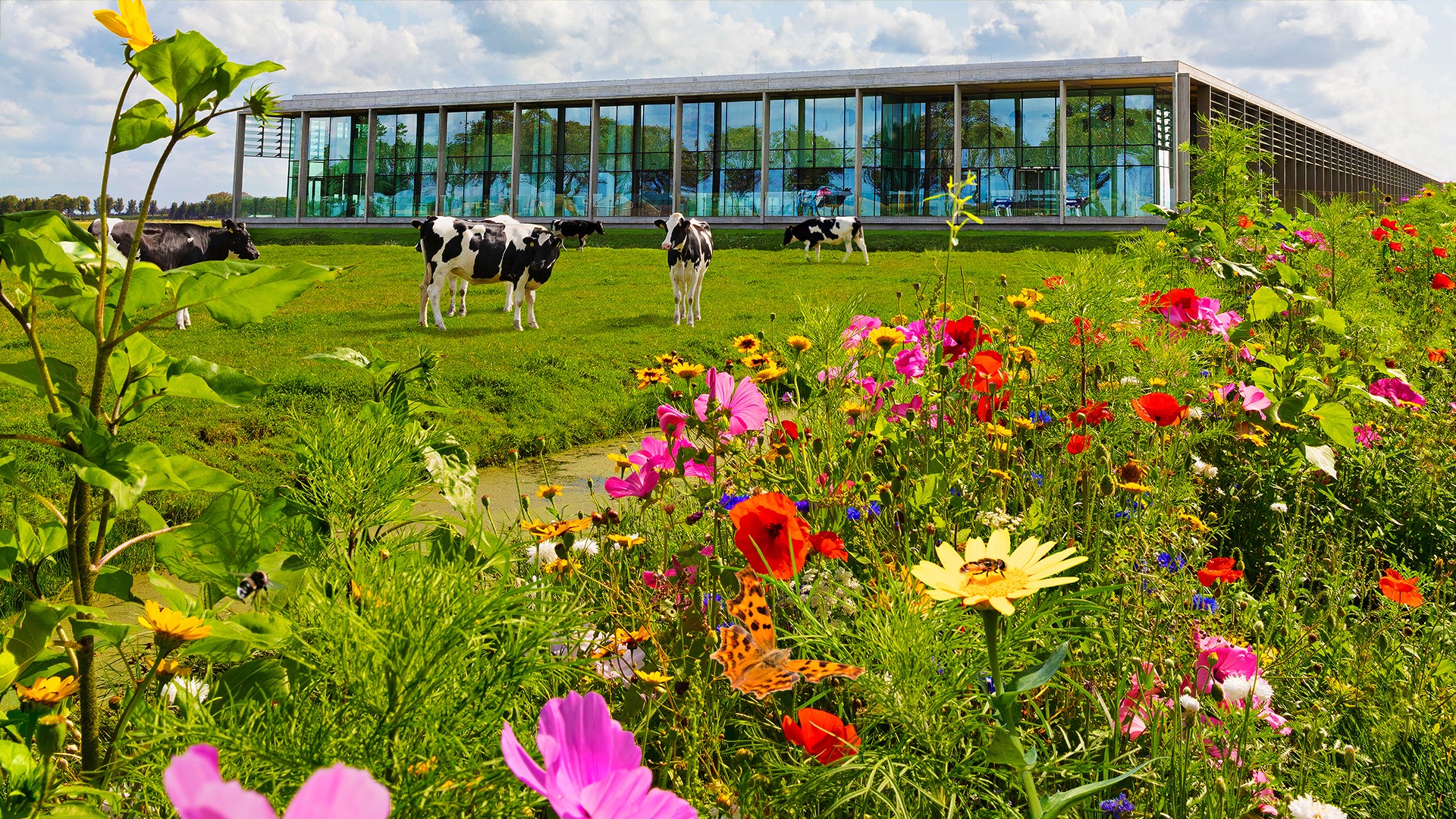
With #IkbenCONO, we show what we stand for as a small cooperative. In this column, our farmers and employees share their stories about craftsmanship, sustainable choices and their work on the farm or in the cheese factory.
At CONO Cheese Makers, we believe that these stories not only inspire and motivate, but also contribute to a transparent and positive future. This is how we show who we are: a cooperative with pride, built on people who work together to make really good cheese.
#IkbenCONO - Together we tell the story of the tastiest and fairest cheese.
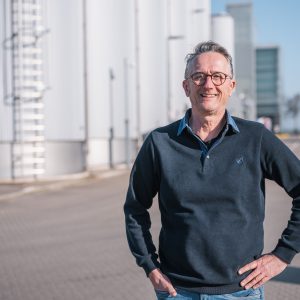
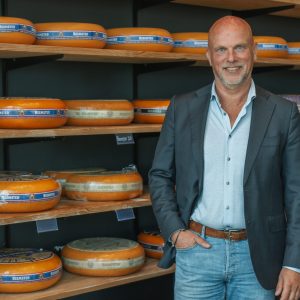
Arthur van Esveld
Arthur van Esveld
“We improve and automate where necessary, while taste and quality remain exactly the same.”
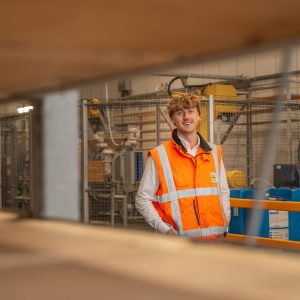
Charelle van Poppel
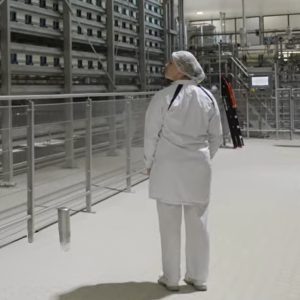
Charelle van Poppel
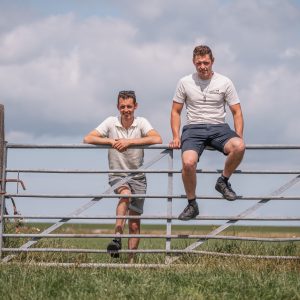
Schilder family
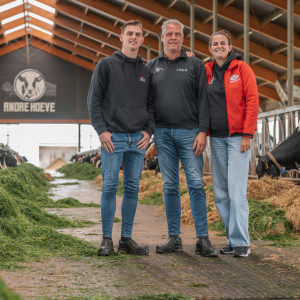
Schilder family
"CONO's standards and values fit in with our way of working."
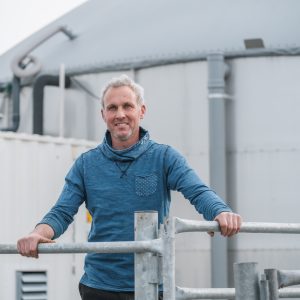
Arno Helder
Arno Helder
Gerland Glijnis
Gerland Glijnis
#IamCONO with Gerland Glijnis
Anyone who hears Gerland Glijnis talk about his dairy farm today would find it hard to imagine that he used to be hardly involved with the farm at all. He is now an entrepreneur through and through and speaks proudly about the developments on his farm.
The Story of Gerland Glijnis
"You have to keep growing, without losing sight of the basics."
Anyone who hears Gerland Glijnis talk about his dairy farm today would find it hard to imagine that he used to be completely uninvolved with the farm. “I started in middle school and didn’t really have much interest in the farm.” Still, that slowly changed.
"I used to ride my bike to high school with a friend every day. On the way, he would often point to a tractor and say, 'Look at that nice tractor over there.' Then I'd say, 'Yeah, that's my dad's.' That's actually where my passion was sparked."
Although his interest was growing, Gerland initially worked outside the home, including in bulb cultivation. He eventually decided to enroll at the Agricultural High School in Alkmaar. He completed the program in three years, after which he went on to the HAS. Together with three classmates, he attended the program in Friesland. "We all stayed together at my mother’s vacation home. That was a wonderful time."
While he was in college, Gerland decided to take over the dairy farm run by his father and uncle. For many years, they had run the farm together, which had about 140 to 160 dairy cows. “When I wanted to continue running the farm on my own, I knew that size wasn’t enough. With just one employee, it would be difficult to make it profitable.”
That is why the decision was made as early as 2003 to expand operations. A new barn was built, and the farm continued to grow step by step. In the years that followed, several dairy farmers in the area went out of business. Gerland had the opportunity to take over their land and a site for young stock. The farm now milks approximately 480 cows in a traditional milking parlor.
His father and uncle are still closely involved with the farm. "They don't milk the cows anymore, and fortunately, they have more time to go on vacation. Still, they can be found on the farm almost every day, helping out with all sorts of tasks."
Teamwork is central to the business. That’s why Gerland deliberately works with a small team of Dutch employees who are versatile. “Everyone here does everything: milking, farm work, and caring for the cows. This keeps the work varied and makes everyone feel responsible for the business. That fosters commitment and a sense of community.”
Although the company has grown significantly, Gerland does not view scaling up as an end in itself. “A larger company isn’t automatically more efficient.” He also remains level-headed about further automation. “Automated milking on this scale, combined with pasture grazing, presents significant challenges. Perhaps the technology will be ready for that in the future, but for now, this way of working suits our farm better.”
Gerland has been supplying milk to CONO Kaasmakers for over three years. That was a deliberate choice. “Before we joined, I had always noticed the pride of the CONO dairy farmers. The CONO flag was flying at our neighbors’ farms, and you could tell how proud they were to supply milk to the cooperative. I really looked up to that.”
He now feels that pride himself. “The short lines of communication within the cooperative really appeal to me. And it’s great that your milk is ultimately turned into a strong brand like Beemster cheese.”
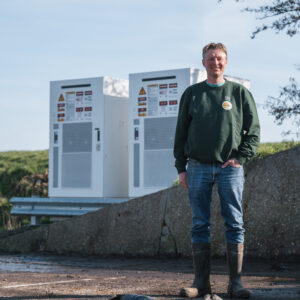
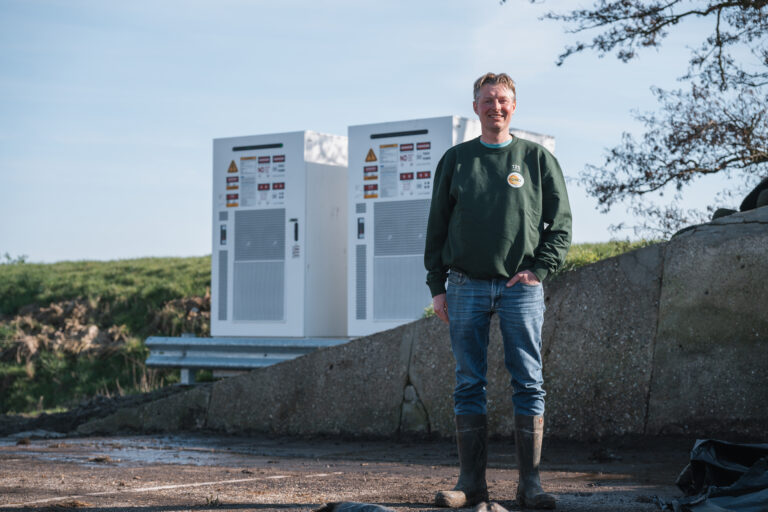
The company also continues to make strides in the area of sustainability. Since early 2026, it has had a battery for storing solar energy it generates itself. This was prompted by increasing pressure on the power grid.
"We already had solar panels on the roof. At the time, I mainly focused on how many panels would fit on the barn. Later, Liander asked me if they could occasionally shut down our solar panels because the power grid was getting overloaded. That felt strange, because we had actually made agreements about feeding electricity back into the grid."
The battery offers a solution to this. "When we can't feed power back into the grid, we store it. Later on, we can use it ourselves or feed it back into the grid. Generating, storing, and then using your own power feels like a nice, complete cycle. That way, we get more out of the energy we produce ourselves."
#IamCONO with our livestock farmers
Young, down-to-earth and future-oriented farming with CONO
The Koorn family's dairy farm in Lambertschaag operates with vision, pride and dedication. Dirk Jan Koorn (24), together with his parents and brother Teun (21), forms the fifth generation of dairy farmers at this location. With strong family cooperation and a clear view of the future, the business is steadily being expanded and optimized. Within CONO Kaasmakers, Dirk Jan has now been active for two years in the Youth College.
A shared vision with each having its own focus
Dirk Jan studied Animal Husbandry in Alkmaar and Leeuwarden and now works fully on the parental farm. He is also active outside in earth moving and arable farming. Together with his brother Teun, he manages the company. "Our vision as brothers is close together. That works well, especially with a view to the future. I focus a bit more on the engineering and machinery, while Teun is mainly concerned with the cows."
Currently, the farm has 180 cows, of which 160 are dairy cows. There are plans to scale up to 200 dairy cows once the new barn is completed. "We are consciously building a future-proof farm structure," Dirk Jan says. "With 56 hectares of house plot, 7 hectares of lease and a land swap with a farmer and bulb grower, we can organize our business operations well. We milk daily in a 24-stand carousel. Robots? There won't be any for the time being; we like to milk ourselves."
Optimizing with an eye on labor and cow welfare
Ease of work is a major focus at the company. "You can only do good work if the work is also practical and efficient. We pride ourselves on the fact that one person can milk 160 cows by himself. We deliberately adapted our walkways and barn layout to that."
Besides expansion, optimization is central, including in cow longevity and production. "We have cows that fit our way of working. That's why we provide our own young stock. The nice thing is that we want to do some things a little differently than our father, however, the well-being of the cows is paramount for all of us."
Involved in CONO, more than just milk price
The company has been affiliated with CONO Kaasmakers since 2001. "My father switched at the time because he had confidence in CONO's way of working and scale," says Dirk Jan. "We share that feeling. It's a small cooperative with short lines, where people know you by name. That gives involvement and recognition."
Dirk Jan himself is active within CONO's Youth College. "I wanted to know more about what goes on behind the scenes. Your milk is collected every three days, but where does it go after that? What exactly does a cooperative do? Within the Youth College you get a good picture of that, through glimpses into different departments such as marketing and management. It's really an added value."
Future: sustainability and responsibility
Within the company, sustainability is practically implemented. There is grazing with an average of 12 hours per day and green electricity is generated via solar panels. There is also active participation within the Caring Dairy program. "It is not a guideline, but a way to look at certain parts of the business. You always learn something from it and it helps with further optimization."
For Dirk Jan, staying close to himself is especially important. "Draw your own plan and stay positive. Don't constantly look at the neighbor, look at what suits you." There is also confidence toward government and regulations. "As a sector, we are used to adapting. What we are vigilant about, however, is how the KringloopWijzer is used. It must remain a tool, not an instrument with which pressure is applied. We are farmers, not office people."
Strong together
To Dirk Jan, CONO feels like a small, close-knit club that achieves great results. "It's special that we can carry an international brand like Beemster® cheese with such a small group of farmers. The general meetings are moments to catch up and stay involved. The short lines ensure that you really are part of the whole. That connection is what makes CONO unique."
men the farmer, guard
"The yellow blood runs through our veins."
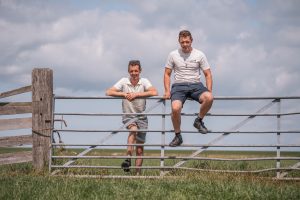
In Warder, North Holland, brothers Eldert and Wimco de Boer, together with their parents, run a dairy farm that has been in the family for nine generations. Eldert (27) lives with his parents at the youngstock location on Klemweg. Wimco (33) lives with his girlfriend and son at the milk production location on the IJsselmeerdijk. Together they milk about 200 dairy and veal cows. All 147 hectares they manage is grassland, including 22 hectares of Forestry Commission land, where ripping of grassland is not allowed. Almost all land work they do themselves, only the dragging they outsource.
In the small polder in which they work, cooperation is natural. Machinery is shared and work is coordinated with neighbors. This connection with the landscape is also reflected in their commitment to meadow bird management. Every spring they search the land for nests themselves. In cooperation with the nature association, over a hundred nesting sites are protected. Not because they have to, but because it suits the area and their vision of corporate responsibility.
Eldert and Wimco also make an active contribution within projects such as "Water, Land and Dikes. For example, they are working together with other parties on bank reinforcement to limit damage caused by geese, crayfish and muskrats. Innovations that contribute to both nature and business are approached with an open mind.
The farm has grown considerably in recent years. Where grandfather started with sixty cows, their father expanded to 120. Eldert and Wimco are now satisfied with two hundred dairy cows. In 2018, the barn was modernized with new roofs, deep litter stalls and windbreak netting. Currently, the focus is on improvements in feed harvesting. For example, rubber plates have been installed to avoid pits on sandy soil and new tub slabs are being built for by-products. In addition, an AMS system is being considered for automatic milking. Not only from a labor perspective, but also because of the importance of free cow traffic, quietness in the barn and less pressure on the udder. According to them, this contributes to a longer life of the cows.
Breeding plays an important role on the farm. The brothers are active at inspections, aiming for a cow that is nicely balanced and fits within the daily operations. Although their father experimented with Fleckvieh and Brown Swiss, Eldert and Wimco consciously chose to return to 100% Holstein.
Grazing is a matter of course. Thanks to the spacious house plots, the cows can easily be grazed daily. In the summer period, the animals get their own feed from the land; only concentrates and a few by-products are fed in the barn. The young cattle are also grazed. From the age of four months the young cattle go outside. In this way they learn at a young age what grazing is all about and the transition as a fresh heifer is smoother. Moreover, it contributes to the muscle development and claw health of the young cattle.
The De Boer family has long been connected to CONO Kaasmakers. Their great-grandfather and even their grandfather's brother were on the board of the cooperative. "The yellow blood runs through our veins," Eldert and Wimco say proudly. What appeals to them about CONO is the transparency, the short lines of communication and the clear vision. If something comes up, they know exactly who to contact. And what is reported doesn't remain on a list. Action is taken.
Eldert and Wimco participate in the Caring Dairy workshop on claw health. While claw problems are minimal on the farm, going deeper into this topic always provides practical insights. Caring Dairy is not a guideline for our operations, but it is a valuable reference point. Many indicators are actively pursued, although fauna damage, especially from geese, sometimes makes it difficult to achieve goals such as "protein from own land". An area-based approach here would fit better in their vision. But is that perhaps something for the future.
"What we find strong about the Caring Dairy program is the exchange with colleagues," Eldert says. "You learn a lot from each other. That always takes you further."
Progress is in moving with you. That is the conviction on this farm. Actively responding to developments as a dairy farmer, instead of going against them, has brought them a lot. The course of CONO fits in well with that. Quality, common sense and pride go hand in hand here.
"The grass sometimes seems greener on the other side," Wimco concludes "Yet, as a cooperative, we are setting up something very beautiful. A strong brand that we create together. If you embrace that, doing business becomes just a little bit easier."
A family business with a future
"I am the third generation at our farm in Hoogwoud," says Daan van Dolder. "In 2000 I took over the business from my aunt and uncle. This year we are 35 years a member of CONO Kaasmakers. The fourth generation is already ready and helping out in abundance. I think the most important thing is that you do what you enjoy. That also applies to our six children. Two sons are interested in the company, one of whom is now studying at the HAS in Dronten. I myself did the MAS in Hoorn. After that I wanted to get to work as soon as possible. However, I did take another practical course in Friesland to develop myself further."
2500 grazing hours
When Daan took over the farm, he immediately made an important choice: the stall barn was replaced with a walk-in barn. "That wasn't easy, but it gave our farm room to grow and innovate," he explains. Daan now milks 90 dairy and veal cows and keeps 30 head of young stock. The barn has room for 130 cows, but growth is not an immediate goal. "I'm more of a cow man than a tractor man," he says with a smile. "We outsource most of the land work to the contractor. My passion is really with the cows."
Grazing is central to this. "Where cows can graze, I let them graze. Corn I do feed, but I buy that. I want to utilize as much grass as possible. Right now our cows walk outside day and night. So we end up with about 200 grazing days a year and over 2,500 grazing hours."
Tradition and improvement
With an average milk production of 8,500 liters per cow, Daan sees plenty of opportunity for improvement. "We have taken many small steps in recent years. For example, we recently invested in new housing for our young cattle. All these improvements contribute to a longer life and higher production. Automating the milking system is not a priority. I milk myself, in our 2x8 herringbone. That is convenient and practical, especially with so much grazing. I sometimes joke: milking is the only thing I'm really good at.
Passion for inspections
Besides working on the farm, Daan is active at the annual Agricultural Show in Opmeer. "I've been participating in that since 2000. It is a wonderful showcase for our sector. Every year 34,000 visitors come and we show them what is involved in our work. For me it's a great way to share our passion and craftsmanship. In the past we also participated a lot in national shows such as the NRM, but nowadays we mainly participate in provincial shows. That fits well with our business and is very satisfying. I also found it very positive that our cooperative had a prominent place on the grounds this year."
Caring Dairy and knowledge sharing
Daan has participated in Caring Dairy from the beginning. "Those three half-days a year are perhaps my best paid hours," he says enthusiastically. "Not only because of the content, but especially because of the exchange with colleagues. Learning from each other, sharing experiences - that makes us stronger as farmers. Personally, I always choose groups focused on cow and farm. That just suits me better."
Involved in CONO Cheese Makers.
His pride in the cooperative is great. "I am proud of the Beemster® brandat we put down together. What I appreciate is that there are always short lines. When I call, I immediately get someone on the line who helps me personally. That feels close and involved. Of course, we farmers sometimes have our opinions about how things are done, but I am convinced that everyone at CONO is doing their utmost to achieve the highest milk price for us. We should think about that more often. Behind every RMO wagon that comes into the yard to collect our milk is an entire organization working hard for our common goal."
Strong together, moving forward together
His message to colleagues is clear and down-to-earth: "We've had the highest milk price in the Netherlands for years. If you are at the top, you know that there will also be a trough at some point. That doesn't matter, as long as we keep putting our shoulders to the wheel together. Our strength is that we are a small cooperative. We do it together, and we have to keep a positive outlook. There is already enough negativity coming at our industry. Let us therefore remain proud of what we are building together: the tastiest cheese in the Netherlands!
Sandra Oudshoorn grew up in South Holland, among the greenhouses on her father's horticultural farm. She always said she would never marry a horticulturist or a farmer cattle farmer. Yet things turned out differently. She met Clemens, and together they moved to the Westbeemster. In 2000, they settled permanently on Jisperweg, where they were milking 55 cows at the time. Sandra and Clemens now jointly run a thriving dairy farm with over 100 cows.
Learning and developing together
Sandra has taught herself a lot about the cows and enjoys being actively involved on the farm every day. She values learning and development. That is why she participates in Caring Dairy in a self-managing group of dairy farmers. Within this collaboration, they exchange experiences and inspire each other. This results in new insights, for example about soil quality. They now use less artificial fertilizer and are looking for natural ways to keep their soil healthy. Sandra and Clemens are also taking steps towards sustainable soil management and water quality through the Water, Land and Dikes project.
Looking ahead with the next generation
Sandra and Clemens have three children, now almost all grown up and still studying. Whether one of them wants to continue the dairy farm in the future is not yet clear. For now, Sandra and Clemens think it is important that their children get the space to choose their own path. Meanwhile, they themselves continue to work on the future of their business, always with an eye on healthy cows, a fertile soil and job satisfaction.
Open to people, with a boundary
The door is always open at Sandra and Clemens' place. Their meeting room in the yard is rented out for a variety of gatherings. They also regularly host school classes or other visitors who want to see for themselves how dairy farming works. Still, there is a clear boundary. Sandra: "We are happy to explain and show visitors everything, as long as there is genuine interest in the origin of milk and the life of our cows. As soon as it feels like we're an attraction, we don't have to."
Cooperation with CONO
Sandra and Clemens experience the cooperation with CONO as positive and involved. They appreciate the short lines of communication and the personal approach. Sandra says: "What many people forget is that CONO was always at the top in times of low milk prices. Now that milk prices are high everywhere, CONO does not opt for quick profits, but for the long term. With an eye for the future and a fair price for us as dairy farmers. That inspires confidence."
With passion for the profession
Sandra and Clemens dedicate themselves every day to their cows, their farm and the environment. From twice-daily milking to careful grazing and being mindful of the soil. For them, it's all about healthy cows that last a long time, a sustainable business and a place where learning and working together come naturally. An approach that perfectly matches the DNA of the Beemster and CONO.
With both feet firmly planted in the clay, with an eye on the future
In West-Friese Hem, not far from the dike towards Enkhuizen, Mark Sluis (45) runs a modern dairy farm together with his wife Linda. Their three children are happy to help out when they can. The family lives and works on the farm where Mark grew up and took over from his parents in 2002. "My father continued to help out for a while, but Linda and I soon took over the day-to-day management. It has now become a close-knit family business."
On the farm, 220 cows are milked in a traditional milking parlour. The farm has 120 hectares of land, mainly grass, a little corn and part of it leased for bulb cultivation and arable farming. Mark manages the land with care and vision. "Land is the basis of everything. The better you take care of it, the healthier the whole system."
Innovation with an eye for sustainability
Four years ago, Mark expanded the barn. That expansion was the starting point for a series of sustainable choices. For example, a Lely Vector feeding robot was installed and he opted for a solid floor. "It took some getting used to, but when you consider the benefits for animal health and the environment, it was the right choice for us."
That investment automatically led Mark to the next step: fermentation. The fermentation system is now running at full capacity on the farm. And soon, an innovative element will be added: the Renure system, which extracts nitrogen from manure and reduces ammonia emissions to almost zero. "That system runs on the heat that is already released during fermentation. That makes it a logical and sustainable addition. A win-win situation."
Not consciously progressive
Although his choices are innovative, Mark does not see himself as a pioneer. "I'm not really into gadgets," he laughs. "But I am curious. And I want to continue farming. So when I see opportunities that contribute to a future-proof business and our sector, I seize them."
His conviction is clear: "The biggest challenges lie in the areas of nitrogen and greenhouse gases. If we don't tackle these, decline will be inevitable. There is now talk of a 20 to 30 percent reduction in livestock. If we deploy innovative techniques on a broad scale, we may be able to prevent this. In the best-case scenario, there may even be room for more cows. Although that is not immediately realistic."
From growth to raison d'être
Mark looks back with pride on the growth of his business. "When I left school, we were still milking a hundred cows. In 2007, after the first barn extension, that number rose to 180. Now we have 220. That growth was never the goal; it just happened naturally. But the focus is different now. It's not about more, but about how. How can we continue to exist as a sector, with an eye for people, animals, and the environment?"
Mark also translates this vision of the future into his role as a director within the cooperative. He recently joined the Board of Directors of CONO Kaasmakers. "I want to work for the collective interest. And I think my experience on the farm and my interest in sustainability are valuable in that regard."
From CRV to CONO
Mark gained administrative experience earlier at CRV, where he was active in the youth board, the department council, and later the advisory board. "I found that educational and enjoyable. You get out of your own backyard, talk to other livestock farmers, and gain insight into what's going on in the sector. That involvement feels enriching."
The move to CONO was an obvious one. "My father was chairman of the Board of Directors for many years. I witnessed his commitment and pride in the cooperative firsthand. We have been supplying our milk to CONO since 1995. And the cooperative's vision fits in with how we work. Down-to-earth, with attention and quality at the forefront."
Forward-looking and positive
Mark has not formulated a specific mission within the Board of Directors. "Above all, I want to listen, learn, and contribute my vision of the future. That vision is sometimes slightly different, and that can be valuable. I prefer to remain realistic rather than idealistic, but that doesn't mean I stand still. On the contrary."
What does he wish for other livestock farmers? "That they can continue to do what they are good at and enjoy doing. If we continue to focus on what is possible, I am confident about the future."
The Schilder family's versatile dairy farm is located in Spierdijk, North Holland. Anyone driving up the driveway will immediately notice that there is more going on here than just milking cows. Every year, in addition to day visitors, they welcome around a hundred groups to their farm. Not only for tours, but also for meetings in the skybox, children's parties, family celebrations, or a visit to the farm shop.
Seated at the table are Bo and Stan Schilder, children of Jolanda and André. Bo (29) has been working full-time in the family business for over four years now. Before that, she worked as a pediatric nurse. However, she became increasingly attracted to entrepreneurship on the farm. What started as a small-scale initiative with her sister Linn, organizing children's parties as teenagers, grew into a serious branch of the business. In 2020, the tide turned: the skybox opened, followed a year later by the farm shop. Today, the sisters run both businesses entirely on their own. "And yes, we still do the parties," laughs Bo. Meanwhile, they are working on a new reception area for the farm. The hay barn will soon offer the possibility of a reception area, including a terrace with its own office space above.
Stan (24) is also very active on the farm. As a sixth-generation cattle farmer, he lives opposite the farm with his girlfriend Paulien and their daughter. Together with Jolanda, Paulien runs the care branch of the business, which was established in 2006. "People of different ages can come here for day care or a place to stay." Stan takes care of the livestock and also helps out with the care. "Caring for people and animals is closely intertwined here. That makes the work extra special," he says.
The family milks 310 cows with an average production of 9,400 kilograms of milk per cow, with 3.64% protein and 4.54% fat. Whereas Fleckvieh used to dominate, Stan has switched to Holstein. On 168 hectares of land, they grow grass and alfalfa (8 hectares), among other things. About 10 hectares of land are leased for bulbs and red beets. In the feed ration, they feed as much (fresh) grass and residual flows as possible, such as chicory, carrots, sprouts, and brewers' grains.
In 2003, André took over the business from his parents. At the time, he started with 45 cows. The business quickly grew to 120 dairy cows, and in 2020, the new, spacious barn opened. It now accommodates more than 300 animals. The exterior of the barn is inspired by the CONO cheese factory. The layout, from box to floor type, has been designed entirely according to André's own vision.
It is no coincidence that the barn is called the ‘CONO barn’. During a workshop, Andre was inspired by the design that CONO had on the table. That drawing became the starting point for the construction. CONO did not contribute to the cost of the barn, Andre emphasizes.
Cooperation is essential within the company. When there are visitors on the farm, there is always consultation about who will take on which tasks and when. From feeding the cows to mucking out the straw pens: everything is done in close consultation. "Everyone knows where they stand," says Stan.
Sustainability plays a major role on the farm. With their own mono manure digester, the family not only heats their farm, but also several surrounding homes. They make the bedding for the deep litter boxes themselves, and batteries will soon be installed to store electricity.
No major changes are planned in the short term. Nevertheless, the focus remains firmly on the future. For example, the family is considering purchasing additional land as soon as the opportunity arises. "We're not sitting still," says Bo. "But everything at the right time."
The family considers the collaboration with CONO to be positive. "The cooperative thinks along with us, is progressive, and fits in well with our way of working. CONO's standards and values suit our company."
They would like to share some advice with fellow livestock farmers: do it your own way. "Stay true to your own vision. Don't compare yourself too much with others. The grass may sometimes seem greener on the other side, but ultimately it's about doing what suits you best."
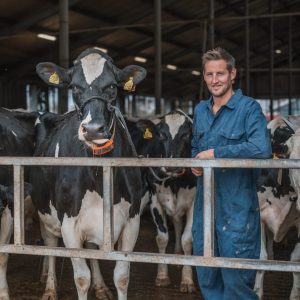
Arno Helder is a cattle farmer who you can wake up in the middle of the night for a beautiful cow. “Breeding is really my thing. I love working on improving our herd. Appearance, strength, milk—it all has to be just right.”
Arno's family business is located on Hobredeweg, right next to the A7 motorway. It is a place steeped in history. After the war, Arno's grandfather moved to Beemster from Starnmeer and the area above Hoorn. He leased the farm, later bought it from the lessor, and steadily expanded it in the years that followed. From eight hectares, the business grew to its current size of 170 hectares, of which approximately 50 hectares are home plots. Nothing remains of the original buildings. What remains is a dedication to the profession.
Arno now runs the business together with his brother, mother, and father. Three years ago, he and his brother officially took over the business. Their parents are still active, albeit to a lesser extent. The barns house 240 dairy and calf cows, 160 young cattle, and a number of breeding bulls. "We keep those for ourselves and for fellow cattle farmers."
The current barn was built in 2012 and is currently being expanded. "We want more space and greater comfort for our animals. Automating the milking system is the next step. For now, we are still milking in a carousel."
Arno's passion lies with the cows. "Caring for them, milking them, breeding them. That's my area of expertise. My brother takes care of the young stock and the farm work. We do a lot of the work on the land ourselves: mowing, tedding, raking, and a large part of the fertilization. About half of the manure is spread by a contractor using a drag hose. We also outsource silage, corn chopping, and ditch maintenance. That makes it easier to plan the work."
A special bloodline runs like a thread through the company. "My father once bought two calves from a cattle farmer in Oostzaan, known for his strong genetics. He named those calves Helma. We are now at Helma 400. That says something about the quality and our love for breeding."
Arno lives in De Rijp with his wife and two children. "It's a bit of a drive, but that also gives me peace and quiet. Home is home. Although, of course, I still keep in touch with my brother, for example when cows are calving."
The connection with CONO is strong. “My grandfather used to supply milk to the cooperative. My father is on the Board of Directors. Personally, I particularly appreciate the personal contact. Of course, there is competition in the milk market, but I remain committed to CONO.”
Finally, a message from Arno to fellow livestock farmers: "Stick to your own vision. Don't let everything you hear and read drive you crazy. See opportunities and go with the flow. Especially if you have successors: go for it."

#IamCONO with Arthur van Esveld
Arthur van Esveld has been a familiar face at CONO Kaasmakers since 1993. For more than thirty years, he has been passionately committed to his profession and to our cooperative.
The story of Arthur van Esveld
From The Hague to the Beemsterpolder
Arthur van Esveld is 63 years old and was born and raised in The Hague. He lived there for over thirty years. After completing his military service, he started working in the dairy industry. He rolled the fresh dairy products at a dairy company in The Hague. He gained experience in production, in the laboratory, everywhere. He took courses and learned the trade inside and out.
When the company merged with a dairy company in Wassenaar, Arthur went along. Two years later, he made the switch to Nutricia. There, product development played an important role in his work. When the company reorganized and he was threatened with a distant placement, it didn't feel right.
And then CONO Kaasmakers came along.
A new step at CONO Cheese Makers
By chance, Arthur saw a job vacancy at CONO Kaasmakers. After six months of commuting, he moved to Hoorn. In 1993, he started working as head of the pre-production plant and laboratory in Beemster and Stompetoren. Cheese making was new to him. His experience was in fresh dairy products. So he did what suited him: he took more courses to specialize in cheese making.
With a passion for his profession and the eye of a master cheesemaker, he grew into his role.
In 2005, the then-manager retired and Arthur became production manager. He was given responsibility for the laboratory, the powder factory, and the pre-factory. During that period, the new powder factory in Beemster was also built. The powder tower in Stompetoren was outdated and in need of replacement.
Outgrowing our clothes
Around 2010, it became clear that CONO had outgrown its premises. The cheese factory had reached maximum capacity. Even a ten-minute malfunction could have major consequences. In the old situation, 132 cheeses were produced from a single cheese vat. Nowadays, that number has risen to 150.
The possibility of renovation and upscaling was investigated. It soon became clear that this was not feasible in combination with continued production. CONO therefore purchased a plot of land next to the existing cheese factory, with the idea that new construction could be a serious option.
An architectural competition was held. The new building had to comply with the rules of UNESCO World Heritage Site De Beemster, with a maximum building height of eight meters, and the length and width of the building had to fit within the contours of the plot with ditches. Once a suitable design had been found, the permit application process began. The course of action was clear: we were going to build something new.
From production manager to project manager
The interim production director asked Arthur if he wanted to become project manager for the new building. He seized this opportunity with both hands. He stepped down from his role as production manager and focused entirely on the project.
One thing was paramount: we would improve and automate where necessary, without compromising quality or taste. That was sacrosanct.
The biggest challenge was in the treatment of the milk and various steps in the cheese-making process, which were to be automated in the new cheese factory, something that was new to many employees. When draining the curds, a conscious decision was made to continue doing this manually. Traditionally, as we have been doing for more than 120 years. Only now on a larger scale. Some things should not be changed. Because that produces the tastiest cheese.
Arthur was involved in everything. From the initial drawings to the driving of the first pile. From visits to Tetra Pak in Sweden to the installation of the automation system. And, of course, the first production run on June 27, 2014, in the new cheese factory. An exciting moment for everyone.
Two cheese factories, one team
After the first production run, an intensive period began. The different types of cheese were transferred to the new cheese factory step by step. Each type underwent cheese inspection. Only when the taste and quality were completely satisfactory was production definitively transferred.
At that time, there were two teams working in the old cheese factory and two in the new one. The sixth team acted as a driving force. They taught the other teams how the new installation worked technically. This involved a lot of trial and error. Minor malfunctions, adjustments, and a lot of consultation. A lot was asked of the people on the floor.
On September 2, 2016, the new cheese factory went into full production with five shifts. This marked the end of Arthur's role as project manager.
Responsible for the entire process
Arthur became production manager and was given responsibility for the entire production process, from milk reception to the brine room. It was a great period with plenty of room for optimization and with extra production capacity that simply wasn't possible in the old situation.
Over the past ten years, new investments have been made. Thanks to advancing insights, processes have been expanded and new flows added. We continue to develop because quality is our top priority.
Together you can achieve more
Looking back on the construction period, Arthur describes it as an enormous challenge and a learning process. He worked with people from different backgrounds and with different experiences. That taught him a lot.
He has now been working at CONO Kaasmakers for 33 years. He has enjoyed every minute of it. What appeals to him? The personal involvement at Cono. CONO knows its people. We give opportunities to our own people, rather than looking outside the company first. That is typical of our cooperative.
Arthur is now entering a new phase in his career. He is handing over his role to Tijs Roeland. The coming months will be dominated by knowledge sharing. He sees this as an exciting challenge.
A message to colleagues
If Arthur wants to impart one thing to his colleagues, it is this: sometimes you need to realize what you have here. Make no mistake. You can rely on CONO. The grass sometimes seems greener elsewhere. But at CONO, they know how to maintain their turf.
Time for a new phase
With his retirement approaching, Arthur is looking forward to a new chapter in his life.
Doing odd jobs for our daughters, three of whom have bought houses. And exploring Europe with my wife in our camper van.
He looks back with pride on a wonderful career at our cooperative. Full of opportunities. Full of challenges. The construction of the new cheese factory was the absolute highlight.
#IamCONO with our employees
To me CONO feels like family, for 34 years"
With his down-to-earth outlook, deep commitment and years of experience, it is impossible to imagine CONO Kaasmakers without Paul Hollenberg. He is 56 years old and has been active in various roles within the cooperative for almost 34 years. What began with an internship with a dairy farmer grew into a career in which he is literally ready day and night for our cattle farmers and drivers.
From the bulbs to the Beemster
Although Paul is originally from the bulb-growing region, his heart was always with cows. At fourteen he started primary agricultural school and did an internship with a dairy farmer in Limmen. "That's where I got my milk diploma" ,Then followed secondary agricultural school, where he immersed himself more and more in dairy farming. "I preferred standing among the cows."
CONO as a springboard
In 1991, Paul started in CONO's warehouse in Stompetoren. He cycled daily from Limmen, while studying at the higher laboratory school in the evenings. After six months he was allowed to work in the powder factory, where he worked for four years. The turning point came in 1995, when then-Director Vos asked him if he wanted to become a milk extraction consultant. "I didn't hesitate for a second," he said.
From then on, Paul was given more and more responsibilities: milk quality, transportation, membership records, rate calculations. "Everything where milk enters the cooperative, I've had my hands on," he says.
Expertise and commitment, from farmyard to cheese factory
Paul is now the point of contact for our livestock farmers in the field of certifications, assurance systems and administrative support. He is also chairman of the staff association, examiner for RMO drivers, member of national working groups such as the NZO and the RMO Control Foundation, and closely involved in training drivers.
His workday doesn't stop at five o'clock. "I'm available 24/7 to livestock producers and drivers. Sometimes it's a report of a hot tank or a gate that won't open at night. Then it's important to have someone think quickly."
Sustainable steps on the road
Paul is proud of CONO's sustainable course, even when it comes to milk transportation. "We work with two professional transporters and are constantly looking at how it can be smarter and cleaner. From smart driving routes to engines that meet the latest environmental standards. Even an electric RMO truck is now making its rounds - during the day still, but in the future also at night if the infrastructure allows it."
Trust and connection
What makes CONO special for Paul is the sense of trust. "We know each other. Not only in the office, also in the yard. That personal connection makes the work extra valuable. The family feeling is something I'm proud of."
Yet he also notices growing pressure on livestock producers. "Milk has never been pulled as hard as it is now. That calls for cooperation. As a cooperative, we have to keep pulling together and keep seeing each other."
His message?
To livestock producers: "Look ahead. There is a lot coming at you, but together you are stronger than alone. Be open to working with your colleagues. There is always something to learn from them."
To colleagues within CONO: "Put your back into it, stay curious and engage in conversation. Seek each other out. Because only together do we make the tastiest and fairest cheese."
From Sandwiches to Cheese
Jef van de Vegte (57) from Blaricum has been working at CONO Kaasmakers for two years. Before that, he worked for ten years at a sandwich producer, which also made sandwiches with Beemster® cheese. It was his first introduction to CONO, "After that I went from being a partner to a colleague," he says.
The move to CONO was a conscious decision. "I always had a shortlist of companies I would like to work for. CONO was high on that list. I love beautiful products and that feeling at CONO was there from the beginning. I was comfortable with my previous employer, but I also felt that I was done there. At 55, I thought: if I still want to do something with my career, now is the time.
A new challenge
After several interviews, Jef made the switch. Since then he has been working as Business Development Manager Trade and leading Beemster New Retail (BNR). 'My role brings a lot of challenge and versatility. I have room to pioneer and that makes my job incredibly fun. In the past two years, I have been involved mainly in everything outside the Beemster® brand, such as Beemster® from the knife, Stompetoren, Weijdeland, Roodbonter, Screen mills and various projects in the traditional channel.'
Digital innovation
One project Jef is proud of is the CONO app for trading partners and cheese specialty stores. 'With that app, they can not only keep up with news and developments, but also earn points by making our brands visible in their store or online. We are now working on the next step: making the app even more relevant and bigger. Such projects give energy, because they make processes smarter and more efficient.'
A doer at heart
Anyone who speaks to Jef quickly notices his practical approach. He calls himself a true doer. 'I strongly believe in learning by doing. Of course you have to have a picture of risks and a plan ready, but ultimately it's about doing things. A good plan does not mean good execution. In the end, the only thing that matters is whether what you do adds something to the bigger picture. At the end of the day, we are a production company. We make cheese and we want to achieve the highest milk price for our members.'
Sustainability as a challenge
Sustainability also features prominently in Jef's work. 'CONO has consciously chosen the sustainable path. For supermarkets we can make that clear to consumers through packaging and labels, but in the traditional channel it works differently. There, the consumer is often more about quality than about sustainability. That sometimes makes it difficult to make our program visible. Yet I see that as a great challenge. Our trading partners need to be well informed, and the app helps with that. Ultimately it is our task to show that sustainability and quality can go hand in hand.'
Respect for our members
What Jef finds special about CONO is the cooperation with the members. 'Before I started here, I actually had little idea about life on the farmyard. Since then I have gained much more insight and, above all, a lot of respect. Our cattle farmers work day and night to make progress. I even find that I can get irritated when their efforts are trivialized in public debates. The cooperative spirit at CONO is unique and tangible. That makes this company different from the rest.'
Pride and ambition
Besides big projects, Jef also enjoys the smaller initiatives. For example, he was involved in the development of the special Leeghwater cheese for the 450th anniversary of Leeghwater. 'That was a great project, especially for our farm stores and our own CONO cheese store. Such things make the work versatile and fun.'
About the future, Jef is ambitious. 'I'm 57, but I still see plenty of opportunities to grow further at CONO. My motivation is great. And to my colleagues I would say: let them know that we make the tastiest cheese in the Netherlands. That is not an opinion, that is a fact. We may not be paying the highest milk price right now, but we will. Because with our quality and our people we simply make the very best cheese.'
In Heerhugowaard-Noord, Jur Stam grew up among the meadows. He now lives there with his girlfriend, in their first home of their own. "It feels good to be back on familiar ground," Jur says, "I've always had a thing for farm life. The cows, the land ... as a little kid riding along in the tractor and later cutting cabbage in the fields, I learned a lot from that. I like that no-nonsense character in the farm, that little culture.
After studying Technical Business Administration at Inholland Alkmaar, he ended up in the coffee world as capsules department manager. He was constantly looking for ways to optimize processes. But could not exploit that in his position. Via a detour as manager of a climbing hall and a three-month trip around the world, he started looking for a company that would really suit him. A family business was high on his wish list. That togetherness, collective passion and pride in one's own product, that gives a certain energy within a company, I like that. At CONO, I found exactly what I was looking for."
A warm welcome to CONO
Jur applied for the position of assistant production manager, but CONO saw a strong match in him for the role of junior project manager. ''They saw that very well,'' he laughs. ''Now more than a year on, I am completely in my place and role.'' These vary widely, from demolishing the old cheese store to building a new water treatment plant. "The great thing about my job is that I supervise projects from start to finish. From the first sketch to the last bolt."
Projects with impact
CONO expressed a clear sustainability goal to make at least a 2% reduction on Gas, Water and Electricity per year. A goal Jur can really appreciate in a company. "I think it's cool that as a company you dare to speak that out loud," he says.
Under Jur's leadership, CONO was already making great strides. For example, the boiler house was insulated to prevent heat loss and save gas. "You see immediate results: less consumption, lower costs and a smaller carbon footprint."
Another major project is the "allergen project. Making mustard cheese creates whey that is considered allergenic. Previously, this entered the same tank as non-allergenic whey, requiring the entire tank to be sold at a lower price. "We created a completely new route with separate pipes, valves and software to automate the process. That separation provides immediate value as well as being a lot more efficient."
Jur is also working on sustainable optimizations that may seem small, but add up to a lot on an annual basis. Like reducing barrier water use. "Lock water cools the seals of valves in production. By looking carefully at the amount per valve, and there are a bump of them, and adjusting the settings, we save drinking water that is also purified twice. That's a win for both the environment and the wallet."
Looking Ahead
Jur is looking forward to a special project: E-CONO, the electrification of our site. "That really is a once in a lifetime project. It requires enormous preparation, technically and in close consultation with our livestock farmers. We looked extensively at alternative solutions to our electricity problem and took all the time we needed to bring our member dairy farmers into the story. I found it very special to be part of the information evenings. Precisely that direct contact gives energy. You are not only doing it for yourself or for CONO, but also for the future and the family of the dairy farmer. That spirit is great and gives an enormous drive."
About CONO, he is clear: "This is a place where I can release my energy. The cooperative never stands still, just like myself. That means I'm far from being out of my depth here."
His message to colleagues is clear: "Cherish the standards and values of our cooperative. They are the foundation of who we are and make us strong together."
Charelle van Poppel is thirty-three years old and has been a familiar face at CONO Kaasmakers for five years. Outside of work, she enjoys spending time with her three horses or riding her motorcycle. She loves living in Waarland, where she moved about five years ago. She is originally from Alkmaar, a true cheese lover, which makes her move to CONO a logical one. Before Charelle started working at CONO, she worked at PepsiCo as a packaging operator. A job in which she learned a lot about production and technology. Yet she continued to search for more depth and development. She wanted to grow, continue learning, and challenge herself further. During that search, she came across CONO Kaasmakers online. The combination of craftsmanship, technology, and training opportunities immediately appealed to her.
It happened quickly. One day after she heard from a temp agency that CONO was a good fit for her, she was already invited to the Beemster for an interview. Shortly thereafter, she started as a cheese maker in training. It's a place where she not only participates in the process, but also has room to develop herself.
Charelle started with Operator A, continued her path with Operator B, and has now also completed her VOBKs. The training courses gave her a solid foundation, although she says she learns most from practical experience. By doing, observing, and asking questions to colleagues. Exactly how things work at CONO: improving together.
Charelle's afternoon shift starts at 2 p.m. She likes to arrive at the location around 1:30 p.m. to have a cup of coffee, catch up with colleagues, and see who is there that day. Then she goes downstairs, through the hygiene lock, into the cheese factory. After the handover, she first does a round. She checks that everything is in order, that the installations are running as they should, and that the product looks good.
“At CONO, we work in three shifts: morning, afternoon, and night. The morning shift is spent cleaning, provided that production has run smoothly.” Which shift Charelle works depends on her tasks. “There are also maintenance days when production doesn't start until the afternoon, for example.”
During the production process, Charelle often works as a second in command and relief worker. While some colleagues have a fixed position on the platform, in the field, or at the drainer, she moves between these locations. As a flying keeper, she provides support where necessary and maintains an overview of the process.
There are eight large cheese tanks on the platform. This is where the process of turning milk into curds and whey begins. Every twenty minutes, a tank is filled and the cheese-making process starts. Add rennet, allow to curdle, cut and process until the curd and whey are separated. The mass is then transferred to the drainage trays and on to the field. Continuous monitoring takes place in the field, using data and the cheese maker's eye. "This way, we work together to ensure that everything keeps running smoothly and the quality is right."
“Various skills are important for the work of an operator. Product and process knowledge, technical dexterity, and a feel for data help in recognizing and resolving malfunctions. It makes the work varied and challenging. You don't learn everything directly from the training program. You learn a lot from each other by sharing experiences and searching for solutions together. You don't have to know everything, as long as you know who to turn to.”
Charelle considers CONO to be a great employer where she still finds challenges every day. She is also looking ahead in terms of her development. Her ambition is to progress to the position of foreman. She feels proud to be the first woman to fill the role of second in command.
If Charelle had to describe CONO in one word, she would call it 'village-like'. Many people, different roles, yet still attentive to each other. "Everyone counts and no one is just a number here. We look out for each other and work together toward the same goal." Her message to colleagues is clear: "Keep looking around you, stay curious, and keep learning from each other. Every day. That not only makes the work better, it also makes it more enjoyable."