
The cooperative
CONO Cheesemakers was established as a cooperative in 1901 by a number of cattle farmers from villages in North Holland. By working together in a cooperative, they were no longer dependent on traders. Moreover, they could now process more milk into products with a longer shelf life, such as cheese and butter.
All dairy farmers in the cooperative were also financially liable as members. A board was elected from the members to supervise policy. As the cooperative grew, a Supervisory Board was also elected from among the members. At the general meeting of members, all members had a say in the affairs of the company. And that is still the way it is today! So the members are still in charge.
Back in time
In this section, we go back to the beginning. To the moment when dairy farmers joined forces because working together felt stronger than continuing alone. That is how CONO came into being: a cooperative built on trust, craftsmanship, and a fair milk price as the basis for the most delicious cheese.
This decision to work together proved to be more than just a temporary solution. For 125 years, dairy farmers, milk drivers, and cheese makers have been working together in perfect harmony. Each has their own role to play, and all are equally important. Traditions are cherished and knowledge is passed down from generation to generation. At the same time, time has not stood still. Work on the farm has changed, transport has become smarter, and cheese making has evolved with new insights and techniques.
Looking back in time shows where we come from and why we are still so strong today.
CONO during the war years
Since 1901, our dairy farmers and cheese makers have formed the cooperative we know today as CONO Kaasmakers. In the Beemster, with both boots in the clay, we work to produce the most delicious cheese. However, there was a period when this was anything but self-evident. The war years put our cooperative to the test and showed us what cooperation really means.
When the occupation began in May 1940, work in our cheese factories changed overnight. What had previously revolved around quality, growth, and cooperation suddenly became dominated by scarcity, rules, and uncertainty.
The government took control of the food supply. Milk, butter, and cheese became rationed products. Everything was distributed via coupons. Production was allocated. Deliveries were monitored. For our cooperative, this meant less freedom, more administration, and constant consultation with authorities such as the Dairy Center.
Collecting milk without gasoline
Fuel soon became scarce. Trucks could barely drive. That is why horse and cart returned to the streets of Beemster. Milk cans were loaded by hand again. In all weathers, carters traveled past the farms to collect the milk.
It was hard work. Roads were poorly maintained. Parts for repairs were hard to come by. A broken axle or worn tire could mean days of delay. Yet the milk had to be delivered to the cheese factory every day. Because milk doesn't wait.
Our dairy farmers continued to deliver. Milking took place twice a day, even when feed was scarce and even when there were concerns about sons who had been called up or were in hiding. The cows came first. Without milk, there would be no cheese. Without cheese, there would be no income.
Production under pressure
In the cheese factory itself, improvisation was the order of the day. Machines ran as long as they could. Spare parts were almost non-existent. Technical knowledge was shared between cheese factories. A mechanic from Oudendijk helped out in Beemster. Parts were reused. Whatever was available was used creatively.
Production also changed in character. Less luxury cheese was made. The emphasis was on basic foodstuffs. Butter and cheese were largely distributed domestically. Foreign trade virtually came to a standstill.
Sometimes there was cheese in storage for which there was no immediate market. Prices fell. At the same time, maintenance and transport costs rose. The board had to manage carefully. Every penny was turned over.
Water, claims, and central kitchens
In the final years of the war, the situation became more urgent. Parts of North Holland were flooded. The area around the Beemster was also affected by flooding. This made transport and work on the land more difficult.
Occupiers seized materials and supplies. At times, parts of a cheese factory were repurposed. One room was converted into a central kitchen to prepare food for people in the Beemster and De Rijp areas. Production and emergency provisions were intertwined.
Power outages made the work extra difficult. Cooling was not always guaranteed. In such cases, quick action had to be taken to prevent the loss of milk or cheese. Cheese makers worked with an eye on the clock and an eye on the circumstances.
The hayloft as a hiding place
In Westbeemster, the Tijd cheese factory played a special role. Beneath the building were two whey cellars. Normally, these were used to store whey. They were cool, dark, and solidly built.
During raids, the large cellar, which was 1.80 meters high, became a hiding place. Boys and men from the village who were in danger of being arrested for forced labor went into hiding there. They waited between the thick walls until it was safe again.
Above them, work continued as normally as possible. Milk cans were moved. The curds were cut. Silence was observed where necessary. Everyone knew what was going on. Not everything was said aloud. Yet people were there for each other.
It is a story that shows what a dairy factory meant at that time. Not just a place of production, but also a place of trust and mutual protection.
Solidarity as a source of support
What characterizes these years is the power of cooperation. Dairy farmers helped each other with feed or labor. Board members kept in touch with members, even when meetings were difficult. Information was shared. Decisions were made together.
In a time of uncertainty, the cooperative offered stability. There was structure. There was consultation. There was a common goal: to keep the business afloat and ensure that a future remained possible after the war.
That future arrived. After liberation, work resumed. Machines were renewed. Collaborations were strengthened. In 1947, forces were officially joined in De Combinatie. Not for convenience, but out of conviction.
The war years shaped our cooperative. They showed us that cooperation is not just a piece of paper. It is an attitude. A responsibility towards each other.
And we still wear them.
Stories from back in time
A Beemster story about milk, people, and working together
To understand the origins of our confectionery factory, we must go back to the beginning of the twentieth century. To everyday life on farms in North Holland. In those days, dairy farming was small-scale, labor-intensive, and closely linked to the rhythm of the seasons. Milking was done by hand. Eight to ten cows per hour was considered a good pace. The day started early and ended late.
Many farms were mixed enterprises. In addition to cows, they also cultivated crops or kept other livestock. This versatility made the business resilient, although it also demanded a lot from the people who worked there. Everything depended on muscle power, craftsmanship, and knowledge passed down from generation to generation.
The North Holland cow
The North Holland cow was a household name during this period. She was known for her milk production and quality. So well known, in fact, that she was exported. That was a source of pride, although it later brought new challenges. Other countries, particularly the United States, were already working with more targeted methods and greater efficiency. Over time, this created competition and put pressure on the traditional market.
Around 1900, this change was still mainly a premonition. Dairy farming was organized locally and strongly focused on self-reliance. However, it slowly became clear that standing still was not an option.
Milk on the go
The milk was milked in the evening and had to be processed quickly. Refrigeration was still in its infancy. Transport was initially by handcart and later by dog cart. Heavy carts were pulled along dykes and narrow roads, often in the dark. The image of men striding determinedly through the polder is characteristic of this era.
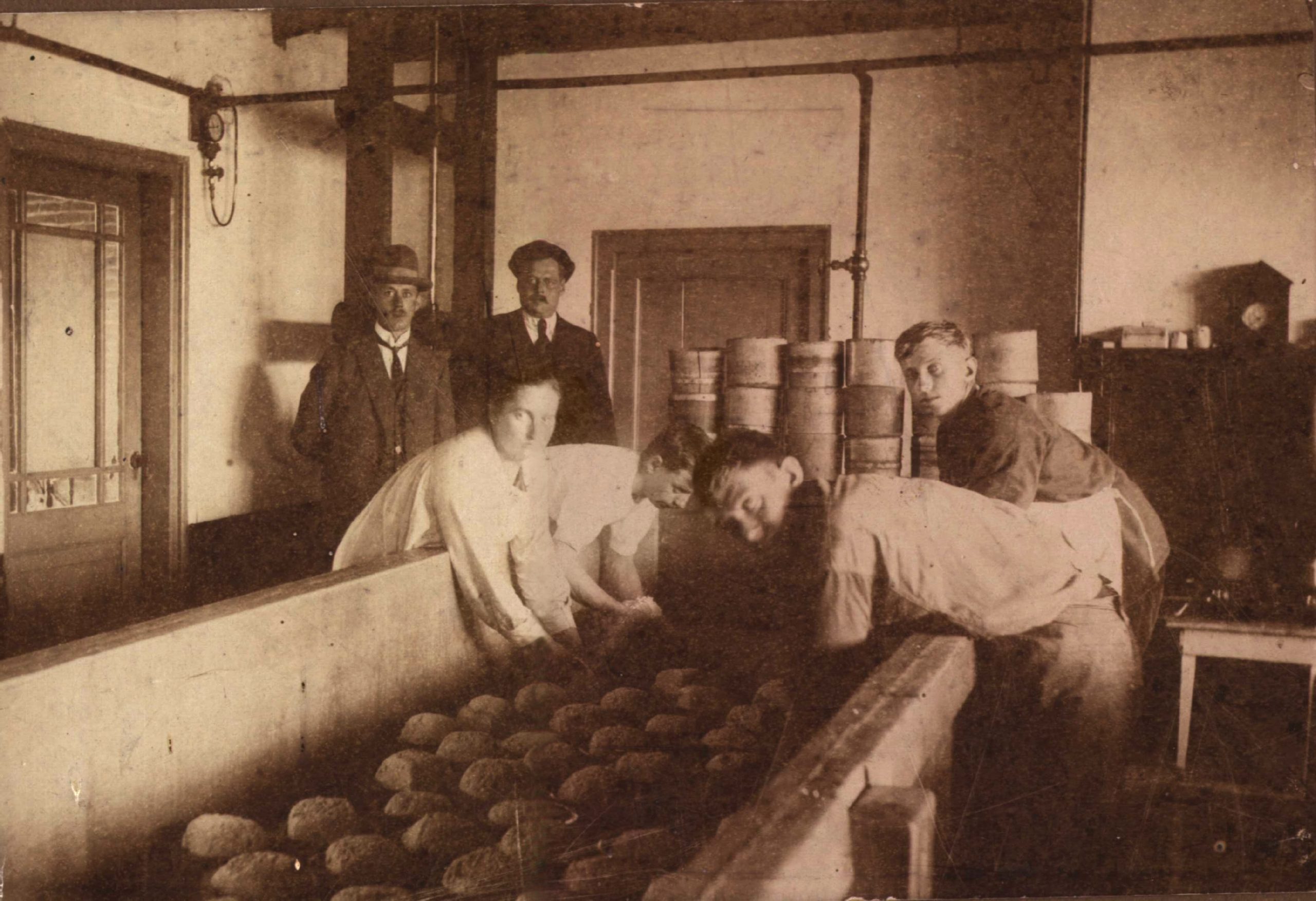
Small factories, also known as cheese factories, were established to process the milk. These were often founded by shareholders who were also milk suppliers. Sometimes the building even had a dual function. During the day, people worked there, and in the evening, meetings were held. Well-known names such as De Hoop, Wilhelmina, De Unie, Arcadia, and De Volharding emerged in the Beemster and surrounding areas. Milk was also processed in Middelie and Neck.
The system worked, although many dairy farmers felt that it was not entirely balanced.
The desire to do it together
The milk was collected, processed, and sold. The dairy farmer's influence remained limited. The price of milk was set by others. Especially at a time when the work remained hard and uncertainty increased, this began to cause friction.
Around 1928, the discussions became more serious. Not at long tables with thick files, but at kitchen tables, in barns, and after meetings. The question was simple yet meaningful:
What happens if we do it together?
The idea of a sweet factory took shape. A factory owned by the dairy farmers themselves. Organized as a cooperative. Joint ownership. Joint responsibility. Joint decisions about the future of milk.
From idea to organization
The first meetings took place in 1929. Interest was high. Discussions focused on risks, previous initiatives elsewhere that had not always been successful, and the tension that comes with investing. At the same time, confidence grew. The time seemed ripe.
People such as N. van Baar, G. Hoorn, P. Otjes, J. Klaver, C. van Diepen, H. Akkerman, and K. de Boer took the lead. Not out of personal interest, but out of a sense of responsibility for the group. They guided the discussions and provided structure.
The decision to form a cooperative felt logical. It meant clear agreements, transparency, and commitment. Articles of association were drawn up. Internal regulations were discussed, amended, and adopted. Everything was done with care and attention to ensure broad support.
A place to build
The choice of location received a lot of attention. Soil conditions, accessibility, and room for expansion were important factors. Ultimately, a site in the Beemster was chosen that not only met the requirements at that time but also offered room for the future.
A building committee was formed. Quotes were requested. Experts were consulted. During a discussion about transport, someone remarked that dog carts had had their day. Everyone laughed. Everyone knew it was true.
Construction began in the spring of 1929. Board members regularly visited the construction site, sometimes in suits, sometimes with rolled-up sleeves. Machines were ordered. The layout was carefully designed with an eye for quality, efficiency, and reliability.
From muscle power to collective strength
The first trial runs in the summer of 1929 brought excitement and relief. Minor adjustments proved necessary, but that was to be expected. Production soon ran as hoped. The members' first milk was processed, and the quality met expectations.
The sweet factory became more than just a building with machines. It became a response to changing times. A place where tradition and innovation came together. The hand-milking farm and the modern factory found common ground in cooperation.
Looking back, the establishment was not a leap of faith. It was a logical consequence of sober reflection, joint decision-making, and daring to act. Precisely as befits the Beemster. And CONO Kaasmakers.
A New Beginning After the War
Since 1901, our dairy farmers and cheesemakers have come together to form the cooperative we know today as CONO Kaasmakers. In the Beemster, with both feet firmly planted in the clay, we work to create the finest cheese. After the difficult war years, a new era began—a time of recovery, of looking ahead, and of building a stronger future together.
The uncertainty of the war gave way to a new sense of energy. There was room again to invest, to improve, and to look beyond tomorrow. We did that the way we always do: together.
From Recovery to Growth
In the 1950s, the work in our cheese factories changed noticeably. Whereas before everything had revolved around scarcity and making do, there was once again room for growth. Milk production increased. At the same time, the number of dairy plants decreased. This meant that more milk had to be processed in fewer locations.
That change called for different choices. Thinking bigger. Working more efficiently. And above all: working together. Increasingly, the focus was on how processes could be better organized to improve quality and strengthen the cooperative.
Stronger together
The cooperative ideal began to take shape during those years. Dairy farmers and cheesemakers found common ground in a shared goal: not each for themselves, but working together to build a stable and future-proof organization.
A key step was the establishment of central facilities, such as the Melco in Heiloo. This led to greater control over milk processing and product distribution. It didn’t happen overnight. Collaboration requires trust. Yet that trust grew as the results became visible. Together, you can achieve more.
Quality starts with the basics
As the business grew, there was also a greater focus on quality. Milk came to be seen more and more as the foundation of cheese. This required care, attention, and expertise.
Dairy farmers were encouraged to maintain high hygiene standards and keep their equipment in good condition. From the milking process itself to cleaning the milk cans: every detail mattered. Because everything a cow produces and everything that happens afterward affects the taste of the cheese.
That way of thinking is deeply ingrained in our cooperative. Good cheese starts with good milk. It’s that simple.
Craftsmanship remains the guiding principle
In the cheese factory itself, the core process remained the same. Milk was treated with starter culture and rennet, which produced the curd. The curd was then cut, stirred, and further processed until it was ready to be pressed and brined. This was followed by the aging process, during which the flavor and character develop.
Technology helped make processes better and more consistent. At the same time, craftsmanship remained central. The cheese master’s eye and experience determined the final result. Some things shouldn’t be changed. Because they’ve been producing the tastiest cheese for generations.
A market that continues to evolve
A lot changed outside the cheese factory as well. Dutch cheese was being exported more and more frequently. Demand grew, though the market remained volatile. Prices fluctuated, calling for insight and cooperation.
In addition, byproducts such as whey began to play an increasingly important role. Nothing was wasted. Everything was put to good use. That reflects how we work: treating what we have with care and making the most of it.
Investing in people and knowledge
Behind every development are people. Dairy farmers who are there for their animals every day. Cheesemakers who do their work with care and precision. And all the colleagues who contribute to the bigger picture.
In the 1950s, significant investments were therefore made in training and knowledge. Young people learned the trade, and experienced workers passed on their expertise. In this way, the craft remained alive and its quality evolved with the times.
Because great work is a team effort. And great work starts with people who know what they’re doing.
Today's Basics
When we look back on the 1950s, we see a period in which the foundations were laid for who we are today. Collaboration grew stronger. Quality became a top priority. And there was a growing realization that progress can only be made if everyone pitches in.
What began as a recovery from a difficult period has evolved into a way of working that is still evident every day in our cooperative—in how we work together, in how we treat people, animals, and the environment, and in the care and attention we put into making our cheese.
A dairy industry in flux
The 1960s were turbulent times. This was true of the world around us, and certainly of the dairy industry in North Holland. Within CONO Kaasmakers and the cooperatives from which we originated, we were searching for a direction. How could we remain future-proof while everything was changing?
At the start of the decade, the landscape was still fragmented. In places like Lutjewinkel, Opmeer, Texel, and the Beemster, there were various factories, each with its own role. This worked well for years. However, it became increasingly clear that scaling up was necessary in order to continue investing in quality and technology.
Mergers and The Combination
This development led to mergers. Cooperatives joined forces to form larger entities. This is how De Combinatie came into being, with factories in Stompetoren and the Beemster, among other places. At the same time, another major player remained active: the Noord-Holland cooperative.
This move brought calm and effectiveness. Still, it didn’t happen without a struggle. There was a lot of discussion behind the scenes. Boards held consultations, member meetings were well-attended, and positions were vigorously defended. Because working together also means letting go of some things.
Closure of Concordia and Warder
Sometimes those choices became very concrete. Take, for example, the closure of Concordia in Oudendijk. On November 30, 1962, the decision was made to close the factory. That decision hit many of those involved hard. This was not surprising, since factories like that were more than just a place of work. They were places where generations of dairy farmers brought their milk and where cheese was made with care.
The factory in Warder also closed its doors later on. With that, a familiar part of the community disappeared. Employees often found jobs at other factories, and the machinery was repurposed. Still, there remained a sense that a chapter had come to a close.
Debate and division
The 1960s were also marked by heated debates. Within De Combinatie, opinions sometimes differed sharply. There were discussions about mergers, collaboration with other parties, and the future of individual factories.
A striking example is the situation surrounding Neerlandia. This party wanted to withdraw from the partnership. This led to legal action and a protracted conflict that even ended up in court in Alkmaar. It shows just how much was at stake. Jobs, livelihoods, and the future of entire regions were on the line.
New partners and milk flows
At the same time, the company was looking to the future. New partnerships were formed with companies such as Nestlé. They had some of their milk processed at De Combinatie, including at the Stompetoren facility.
That provided certainty. For the factories, which were able to keep operating. And for the dairy farmers, who were able to sell their milk. Multi-year contracts were signed. That brought a sense of calm during a period of great upheaval.
The arrival of the milk tank
Meanwhile, just as much had changed on the farm. The introduction of the milk tank was a major step forward. Whereas milk used to be collected in cans, the farm now had its own refrigerated storage facility.
In 1969, only a few dairy farmers were using milk tanks. By 1970, that number had already grown. It marked the beginning of a trend that has become an integral part of the industry. The milk stayed cooler and was transported in larger quantities, which improved its quality. And you can taste the difference in the cheese.
Quality and Control
During the same period, inspections of milk and cheese were tightened. Clear standards were established for fat content and composition. Milk was evaluated and classified into grades.
Milk of the highest quality was designated as “first-class milk.” This gave dairy farmers an extra incentive to continue investing in quality. At the same time, stricter controls were implemented regarding issues such as hygiene and the presence of undesirable substances.
As we still believe: good milk is the foundation of the best cheese.
Investing in cheese factories
There was significant investment in the cheese factories. At De Tijd, a new, more mechanized cheese factory was put into operation. Old cheese vats were replaced by modern equipment such as curd makers and conveyor belts.
Production capacity grew significantly. The amount of milk that could be processed continued to increase. Other factories also adjusted their production schedules. In the Beemster region, for example, production focused entirely on Gouda cheese, in various weights.
Yet craftsmanship remained the guiding principle. Machines supported the process, but it was the cheese master’s eye that determined the quality.
Overproduction and storage
This growth also brought challenges. More cheese was being produced, and it had to be sold. Sometimes inventories built up. Cheese was stored, for example in warehouses like Concordia’s, to be sold later at the right time.
That called for insight and cooperation. Striking a balance between production and sales became increasingly important.
Together Through Change
Looking back at the 1960s, we see a period of great upheaval. Mergers, closures, new technologies, and heated debates. It was all happening at once.
Yet the core remained intact. Dairy farmers and cheesemakers continued to work together. Everyone contributed. Everyone had a say.
That is exactly what makes a cooperative strong. And it is what still defines CONO Kaasmakers today.
Unrest in the sector, decisions within the cooperative
For CONO Kaasmakers, the 1970s began at a time when the agricultural sector was clearly under pressure. Those were not easy years. Many dairy farmers faced rising costs, changing regulations, and uncertainty about the future.
This had consequences. Businesses were closing down. In rural areas, milk tanks became available from dairy farmers who were shutting down their operations. This created a mixed picture: opportunities for growth, yet at the same time the realization that the industry was under pressure.
Within CONO, this was viewed with a level-headed perspective. We didn’t look the other way; we took action. It was precisely during this period that it became clear how important it is to stand together as a cooperative. Only in this way can we continue to invest in quality and continuity.
The turnaround in the yard
One of the most noticeable changes took place among our dairy farmers.
Where milk cans had been used for years, the transition to tank milk began. It wasn’t an easy process. Purchasing a milk tank was a major investment, especially at a time when not everyone was certain of their future.
Nevertheless, more and more members took that step. In 1969, there were only two milkers within CONO. By the mid-1970s, that number had risen rapidly, and by 1980 there were 332.
This means that virtually the entire cooperative switched to a new way of working over the course of more than ten years.
The effect was immediately noticeable. The milk was stored in a refrigerated facility on the farm, which significantly improved its quality. Variations decreased, and the foundation for consistent cheese production was strengthened.
The Introduction of the RMO
With the advent of bulk milk, transportation also underwent a fundamental change.
During those years, CONO began using mobile milk collection trucks, known as RMOs. These trucks could carry approximately 9,500 liters of milk and picked it up directly from the dairy farmer.
That was a turning point.
Whereas milk cans used to be loaded, transported, and unloaded, the milk was now transported from the tank to the factory in a single closed system. This reduced the risk of contamination and ensured much more consistent quality.
For dairy farmers, it also meant a change in their daily work. Less physically demanding work, less reliance on fixed pickup times, and a smoother process.
The transition took place step by step. In some areas, the bus remained necessary for a while longer, for example due to distance or infrastructure. Nevertheless, the direction became increasingly clear.
In January 1979, the bus milk collection point in the Beemster was permanently closed. In Stompetoren, there was still one remaining collection point where the last bus milk was delivered.
In 1981, the very last batch of bus milk was unloaded there.
A moment that marks the end of an era at CONO.
Investments in Stompetoren
While the changes were visible in the yard and along the way, the cheese factory was hard at work on expansion and modernization.
In the early 1970s, major investments were made in Stompetoren. Four new cheese tanks, each with a capacity of 12,000 liters, were installed. This significantly increased production capacity.
In addition, the Edam cheese production process was modernized. With the introduction of a curd dosing machine, cheese vats could be filled automatically. The capacity was around 1,200 cheeses per hour.
The process of branding cheese was also mechanized. Whereas this had previously been done by hand, technology took over this task.
Still, the process wasn’t fully automated. The master cheesemaker supervised and made adjustments as needed. The craft remained the guiding principle.
New Construction and Logistics
The growth required more space.
In 1974, a new cheese factory, a brine cellar, and a warehouse were put into operation in Stompetoren. This was no small expansion, but a clear step toward the future.
A key component was the updated brining process. Using a continuous deep-brining system, the cheeses were automatically moved through the brine bath. This ensured uniform treatment and consistent quality.
Storage capacity was expanded from approximately 150 tons to 220 tons of cheese. This enabled CONO to process larger volumes and better respond to market demand.
Quality as a measurable performance metric
During those years, the concept of quality became increasingly concrete.
Milk was systematically tested for odor, cleanliness, fat content, and bacterial quality. The results were recorded and shared with the dairy farmers.
A clear standard emerged. And that included recognition.
In the 1979–1980 fiscal year, 109 dairy farmers made the honor roll. They delivered milk for an entire year without a single penalty point.
Some companies performed even more consistently. One dairy farmer even managed to maintain this for nine consecutive years.
Those aren't just numbers. That's dedication to the profession.
Increase in supply: a milestone for CONO
The joint efforts of dairy farmers and the cheese factory led to growth.
An important milestone was reached as early as 1971, when one million kilograms of milk were delivered to De Tijd in the Beemster in a single week.
An even bigger milestone followed at the end of the decade. In the 1979–1980 fiscal year, the 100-million-kilogram milk production mark was surpassed for the first time.
The total catch amounted to 108 million kilograms.
This shows just how much the cooperative had grown, despite the difficult conditions in the sector.
Organization in the process of development
The growth and changes also called for a different organizational structure.
The works council was established in 1976, with representatives from various divisions of the company. This gave employees a clear voice within the organization.
In addition, work was done to develop a new organizational structure that would better align the various components of the cooperative.
The goal was clear: a single, strong, well-organized cooperative where everyone knows their role.
CONO is getting a recognizable look
During those years, efforts were also made to raise CONO’s profile.
The name, which had long been used as an abbreviation for Combinatie Noord-Holland, took on greater significance. With the introduction of its new logo in 1972, CONO became a recognizable name in the industry.
On milk trucks, in factories, and in promotional materials.
A name that says something not only about where we come from, but above all about how we work together.
One story, created by many
When you look at the big picture, you don’t see isolated developments. You see a cooperative in motion.
An industry under pressure. Dairy farmers who are retiring and others who are investing. New technologies making their debut. And an organization that is evolving alongside them.
And there is one clear thread running through it all.
We remain committed to quality. We continue to invest in our craft. And we do it together.
Because we know how it works: without dairy farmers, there’s no milk. And without milk, there’s no cheese.
The cheese factory
Several small dairy cooperatives were already active in North Holland at the beginning of the 20th century. In 1947, three North Holland cheese factories decided to work together; Concordia from Oudendijk, Ons Belang from Middelie and De Tijd from the Beemster. Together they formed the cooperative 'De Combinatie'. Then Neerlandia from Stompetoren joined. Since 1991, CONO Kaasmakers has also worked together with the CFM De Vechtstreek cooperative. Through this cooperation, CONO Kaasmakers produced cheese, butter, milk and whey powder at locations in Beemster, Ommen and Stompetoren.
The factory in Ommen became independent in 1996 under the name Hyproca Dairy. In 1997, a legal merger saw the Ommen de Vechtstreek cooperative merge into CONO Kaasmakers. Most of the milk from the members in Ommen goes to the ice factory in Hellendoorn for Ben & Jerry's ice cream in Europe.
In the Beemster Polder, right among the cows, stands cheesemaker 'De Tijd' where cheese is still made just like 100 years ago. In the past 15 years, CONO Cheese Makers has been able to pay its members the highest milk price and, in honour of its 100th anniversary in 2001, CONO Cheese Makers was made a purveyor to the Royal Household. As a unique region, the Beemster Polder was declared a UNESCO World Heritage Site in 1999. In November 2014, the new sustainable cheese factory in the Beemster was opened by HRH Máxima.