
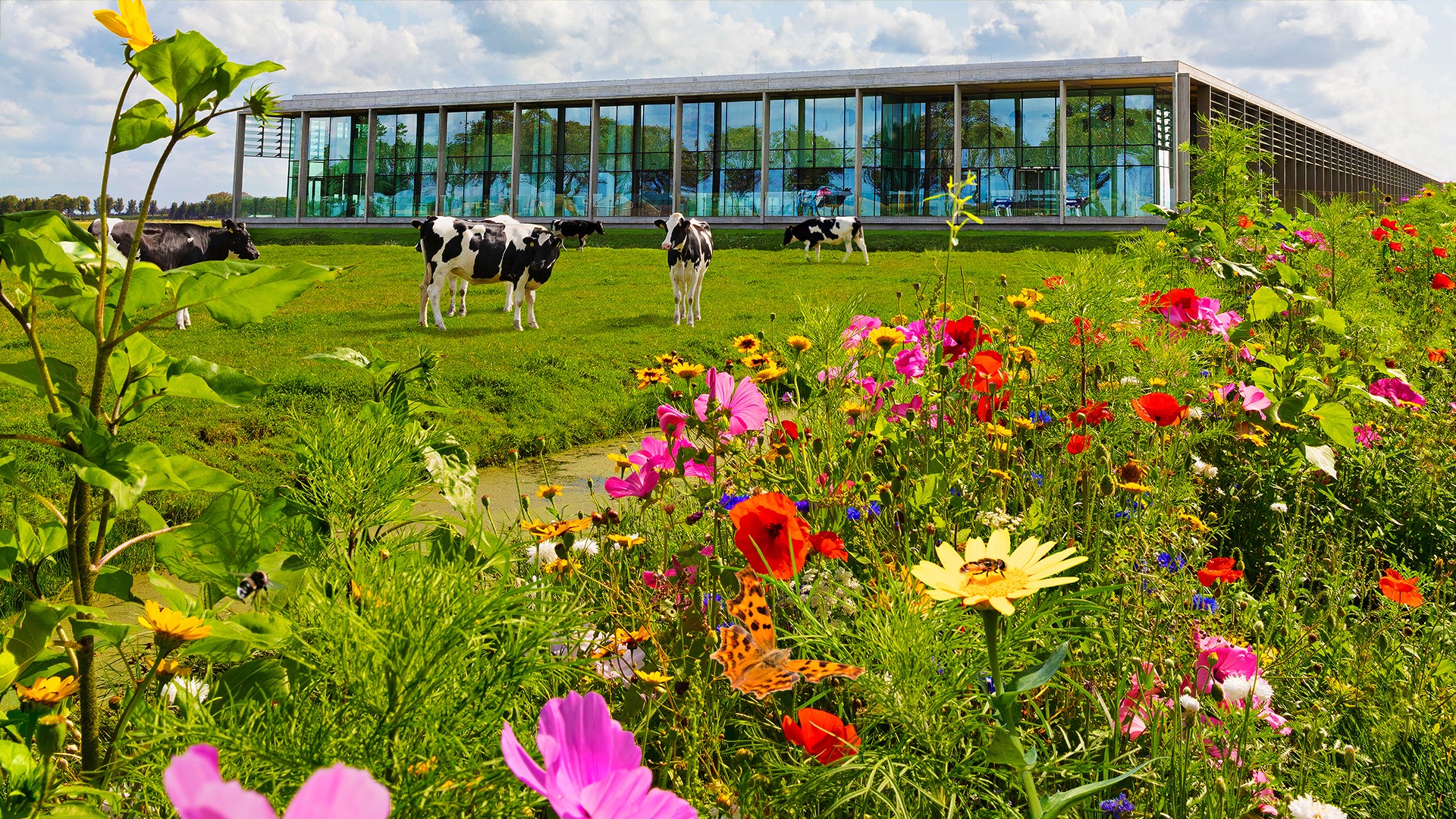

Sustainable cheese making in progress
The production line of the CONO cheese factory consists of the latest and most economical equipment. But more is needed to make cheese as sustainably as possible. For example, not running all those economical machines any more than necessary. Because every cheese more than the demand from the market is also waste.
Right from the new building, the most efficient techniques have already been applied. With only one goal: the best cheese with as few resources as possible. "No waste of energy, but also of milk and other raw materials. Just right the first time," says Harco de Jager, Managing Director of Operations. And although CONO knows everything about making cheese, all building partners were also challenged to come up with innovative solutions. The result: the current cheese factory is thirty to forty percent more energy efficient per kilo of cheese than the old one.
"Better two cheeses too little than one cheese too much".
Smart techniques
Numerous clever techniques have been applied. For example, the milk arriving directly from the farms must first be skimmed. This is done in a centrifuge, or rather a vacuum centrifuge. Because this spins without resistance, less energy is needed. Then the cold milk is heated and cooled again. By passing tubes with new cold milk through tubes with hot milk, energy is saved on both sides. After all, the hot milk is cooled down 'for free' by the cold milk, and the new cold milk is also warmed up 'for free' by the hot milk. This so-called heat exchange runs like a red thread through the entire process of making cheese. Another example: milk consists for about 90 percent of water. When making cheese, the solid substance (the curd) is separated from the liquid (the whey). By filtering the whey well, reasonably pure water remains. Ideal for cleaning the cheese factory! The curd eventually goes into the cheese warehouse to mature. Fourteen degrees is the perfect temperature there. The smartest part of the cheese warehouse? Right, under the ground!
Operational excellence
"You can have an extremely economical car, but if you accidentally keep making detours, then you are still wasting energy because of those extra kilometres," explains De Jager. "That is why we go for operational excellence in the cheese factory. Apart from energy-efficient machines, that is mainly a question of behaviour and choices. Not preventing or quickly solving a breakdown while the entire production line is in full operation is lost energy. Making the wrong cheese is lost energy. Making too much cheese is lost energy. That is why we do not make more cheese than the market requires. And when we are done with that, then as far as I am concerned the light goes out and the door is closed. This tight combination of techniques and measures yields great gains in sustainability. But that is not the end of our ambitions. De Jager: "My goal is that we use 2% less energy each year, measured in gigajoules per tonne of cheese.
Sustainable employer
To successfully achieve both the tastiest cheese and the most efficient production, the quality of the cheese makers is obviously crucial. Therefore, CONO runs the continuous improvement program TOPP. Components include awareness of everyone's own share in sustainability. And sharp analyses, so that it is clear whether a disruption is in technology or in behavior, so that adequate adjustments can be made. "The great thing is that because of this sustainable attitude, many young people also want to work for us," De Jager points out. "Sustainability is totally contemporary. We know how to combine it with a beautiful natural product. As CONO, we want to be an attractive employer where people are challenged and can develop sustainably. Our sustainable cheese factory is now fast becoming one of the best employers in North Holland."