
CONO Kaasmakers is a small farmers' cooperative with a big ambition. Together we go for positive for future generations, doing everything we can to pass on our world to the next generation in a positive way. We work in a transparent way to make the tastiest cheese. In doing so, we make no concessions whatsoever to the quality and taste you have come to expect from our cheese.
Together, positive for future generations.

Together for the future generation

Sustainable Development Goals (SDGs).
Climate Ambition
Climate Ambition
CONO wants to be involved and close to society. We realize that our actions have an impact on the climate. That is why, as a cooperative, we are committed to the Sustainable Development Goals set by the United Nations in 2015. With the goal of making the world a better place.
How do we do that?
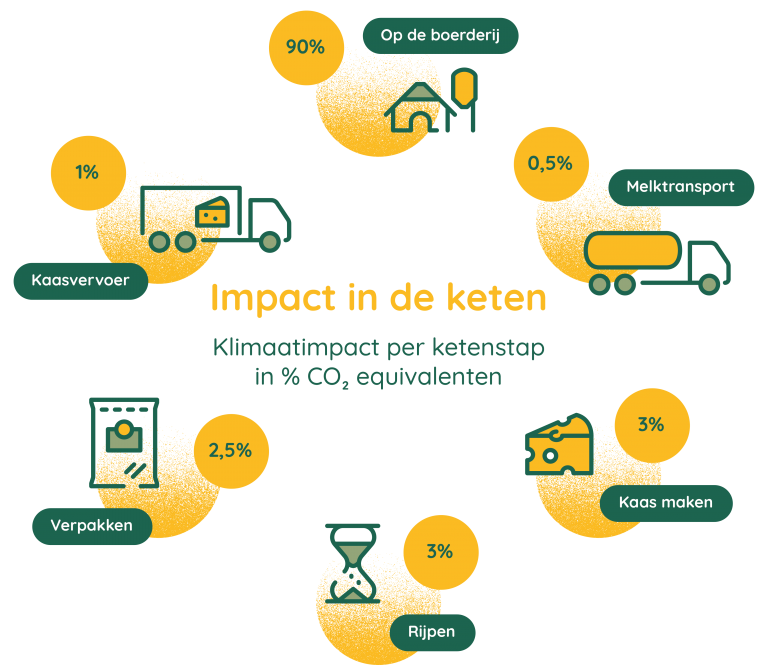
We do this throughout our cheese chain from cow's mouth to store shelf. We first make our own share of CO2 as small as possible.
CO2 emissions are measured in so-called 'kilograms ofCO2 equivalent per kilogram of CONO cheese'. An objective calculation model is used for this, namely a life cycle analysis by Blonk Sustainability. It boils down to this: the lower, the better. We calculated that by 2030 we can reduce emissions by about 30%. We do this in five areas in the chain "from cow's mouth to store shelf": On the farm, milk transport, cheese making, cheese ripening, packaging and cheese transport. We do not include by-products and side streams such as cream and whey powder.
On the farm, we are exploring the possibilities of circular farming and carbon farming, which is aboutCO2 sequestrationunder grassland and trees, for example. And as soon as there is a proven innovation for our cheese making that suits us, such as biogas, hydrogen, geothermal energy, and heat networks, we link up. Increasing sustainability is a process in which we constantly adjust, look for innovations and work together with our dairy farmers and partner to create a future for the next generation.
Working together to lower footprint in dairy chain
In the Low Carbon Dairy project, the WUR (Wageningen University Research), together with the two dairy chains CONO Kaasmakers/Ben & Jerry's and Vreugdenhil/Nestlé and other parties, is investigating how greenhouse gas emissions in the dairy chain can be significantly reduced. The goal is ambitious: 50% less emissions per kilo of milk on dairy farms, as a first step toward a climate-neutral chain in 2050 (net-zero). The project is a PPP (public-private partnership) and means that business and government are each financing 50%.
The project builds on two existing initiatives within the dairy sector, both of which are focused on sustainability. The central question is how this sustainable transition can be realized in practice. The focus is on reducing greenhouse gas emissions and strengthening circular agriculture and regenerative agriculture.
Although there are already many known measures to reduce emissions, there is not yet a concrete and tested set of solutions specifically aimed at achieving 50% reduction. To give a picture, the target is between 685 and 775 grams of CO₂ equivalents per kilogram of milk. Currently, that average on Dutch dairy farms is between 1000 and 1550 grams.
In this project, the participating parties find out which measures really work, what they cost and what they deliver - not only for the climate, but also in other areas of sustainability.
At CONO, it all starts with our cows and livestock farmers. What sustainable steps does the farmer take on the farm? See the beginning of the chain here.